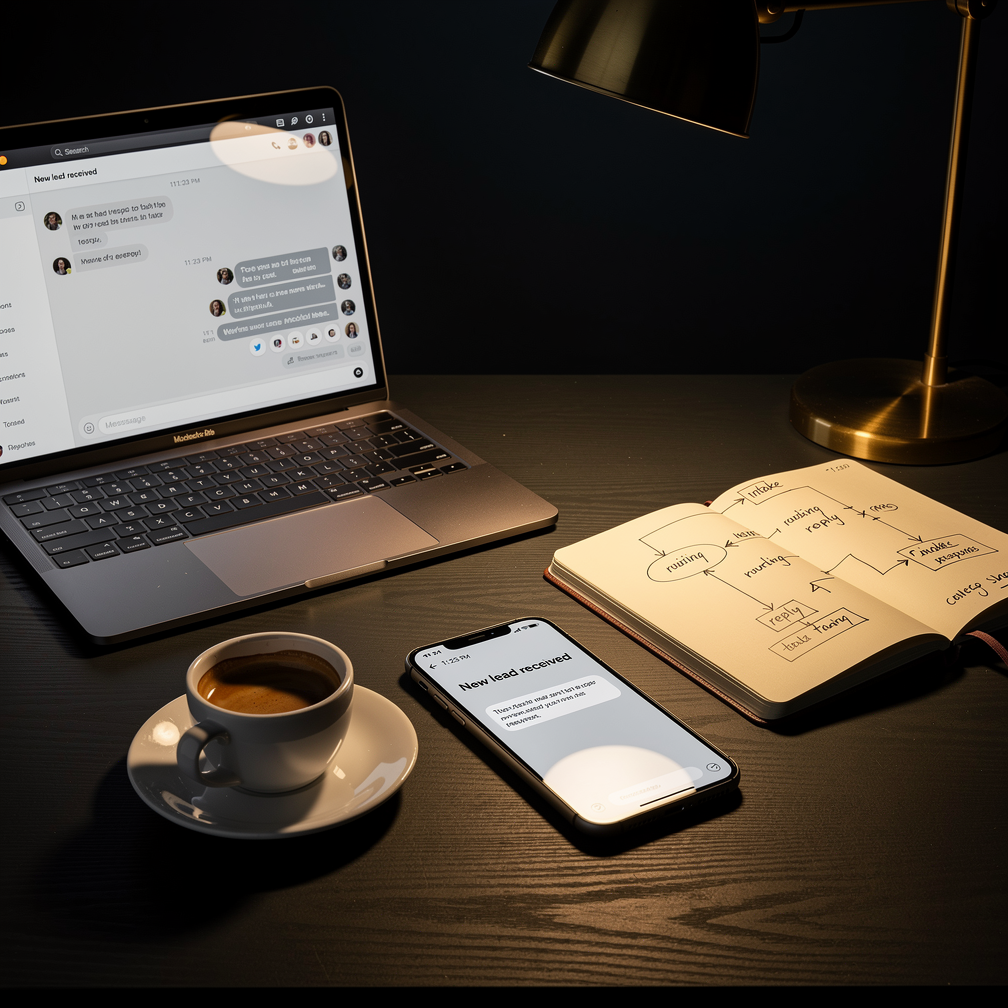
# The Lead That Replied at 11pm Wasn’t Lucky. It Was Automated.
Two businesses. Same Tuesday night. Same qualified lead.
A contractor in the Pacific Northwest submits a form at 11:04pm. He’s been meaning to do it for three weeks. The kids are finally asleep, the house is quiet, and he’s got 20 minutes and a beer before he crashes. He hits send. He wants a quote. He’s ready.
**Business A** gets the notification at 11:04pm. The owner sees it Wednesday morning at 7:38am, between coffee and the first call of the day. He replies at 9:15am with an apologetic “Thanks for reaching out!” The lead has already signed with someone else.
**Business B** gets the same notification at 11:04pm. By 11:04:07, the lead has a text message. Personalized. Specific to what he submitted. With a link to book a call. He books it before midnight.
One of these businesses looks like it has supernatural response rates. It doesn’t. It has a system.
—
## What “Being Available” Actually Means
Here’s the myth that’s been sold to every service business owner for the last 20 years: responsiveness is a virtue. You are available because you are dedicated. You reply fast because you care more.
That’s not wrong exactly. It’s just incomplete in a way that will cost you real money.
Because here’s the actual mechanic: a lead who reaches out at 11pm is still in buying mode at 11pm. They’ve worked up the nerve, done the search, filled out the form. That moment is alive. It has a half-life. And if your business only replies when *you* are available, then your conversion rate is being set by your calendar — not by the quality of your service.
34% of weekly inbound leads arrive between 9pm and 7am. That’s not fringe activity. That’s your pipeline, quietly leaking every night while you sleep.
This is not a “hustle harder” conversation. It is not a “set boundaries and protect your mornings” conversation either. It’s a math conversation.
—
## The Math of the Gap
Research on speed-to-lead is brutal if you look at it honestly. Businesses that respond within the first minute convert leads at dramatically higher rates than those that respond within the hour. Wait until the next morning and you’re not just slower — you’re often irrelevant. The lead has moved on, cooled off, or already booked a call with whoever replied first.
Think about what that means across a year for a law firm, a consulting practice, a remodeling company. If your average closed deal is $5,000 and you’re losing two leads a month to response lag — that’s $120,000 a year walking out the door at 11pm while you sleep.
Not because your service is worse. Not because your price is wrong. Because you replied at 9am and someone else replied in seven seconds.
That’s the number. That’s what this is actually about.
—
## How the System Works (Non-Technical Version)
I’m not going to walk you through a technical stack here. But I’ll tell you what the functional pieces are, because it’s not as complicated as it sounds.
The businesses that respond at 11pm have wired together roughly four things:
– **A trigger**: the form submission, the DM, the inquiry, the quote request — any signal that a human showed up and wanted something
– **An instant first reply**: SMS or email that sounds like a person, not a ticket confirmation — specific to what they submitted, warm, clear on next steps
– **A routing rule**: is this a high-intent lead who needs a human fast, or a routine inquiry that gets handled automatically? The system decides, not the owner
– **A follow-up cadence**: if they don’t book, they hear from you again. And again. Until they do something — book, opt out, or go cold
That’s it. The owner doesn’t touch any of it. They show up in the morning to a CRM that already knows what happened, who’s qualified, and what needs a human decision.
The goal is not to automate the relationship. It’s to automate everything *before* the relationship starts, so the relationship can actually start.
—
## The Non-Negotiable Trigger List
If you’re a service business with any kind of after-hours inbound, these are the automations that aren’t optional:
1. **New inquiry → instant first-touch reply** (under 60 seconds, ideally under 10)
2. **No-reply follow-up** at 24 hours, 48 hours, 72 hours — then done
3. **Booking confirmation + reminder sequence** (if they schedule a call, they should get reminded twice before it happens)
4. **Re-engagement trigger** for leads who went quiet after initial contact
5. **Internal alert** for high-intent signals — so you know when to step in personally
What stays human: anything that requires judgment, empathy, negotiation, or nuance. The system catches them. You close them. That’s the division of labor.
—
## One Thing You Can Try This Week
If you have a contact form, a Gmail account, and five minutes — turn on an auto-responder for after-hours inquiries. Set it to fire between 6pm and 8am. Make it sound like a person, not a robot. Say something like: “Got your message — I’ll have something useful for you within a few hours. In the meantime, here’s [one helpful thing].” It won’t replace a full automation stack, but it stops the silence that tells the lead no one’s home.
—
Here’s the reframe I want to leave you with.
The 11pm reply is not proof that someone works harder than you. It’s proof that their business never went offline. There’s a version of your business that catches every lead, responds to every inquiry, and never once requires you to be awake for it. That version isn’t some future fantasy. It’s a system design problem — and those are solvable.
Your business doesn’t need you to be superhuman. It needs infrastructure that works on a clock you don’t have to keep.
If you want to see what that looks like mapped to your specific operation, [start here](https://flowstateops.com).
—