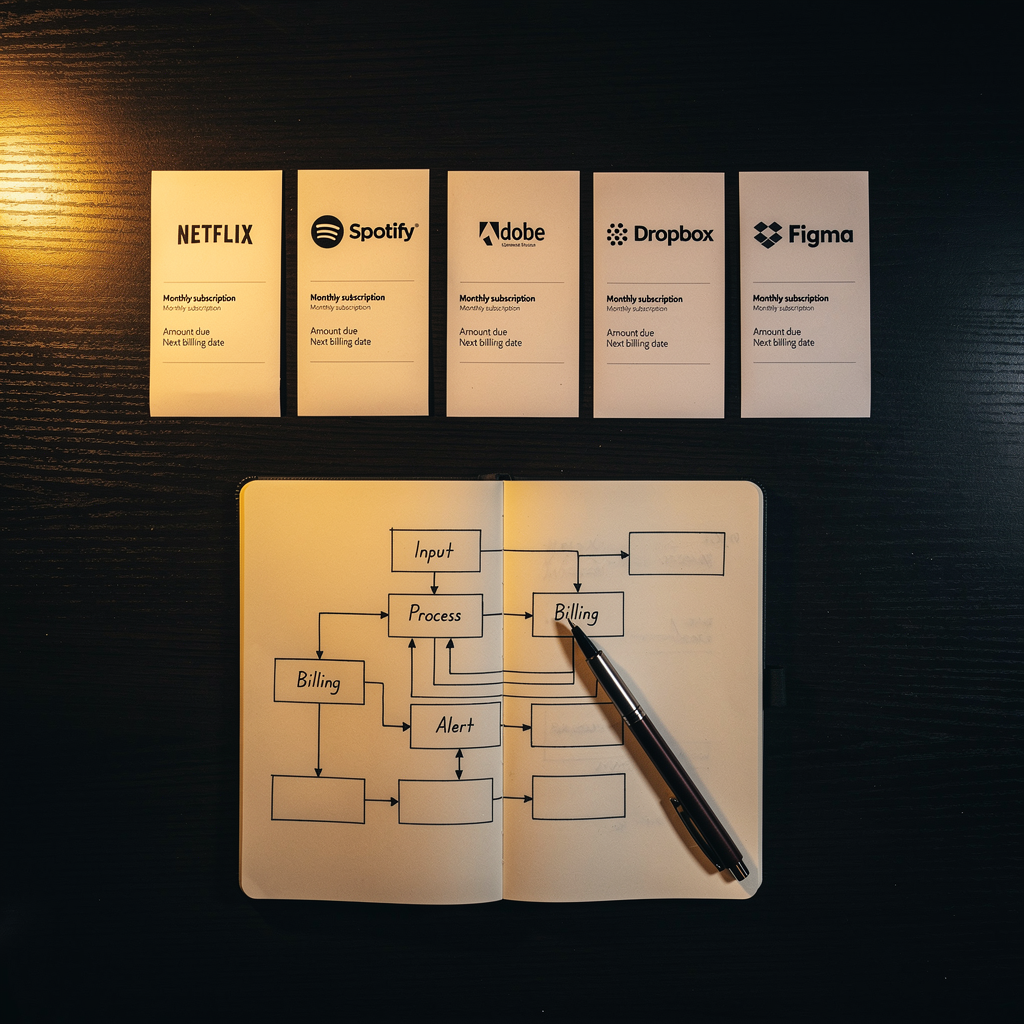
Four Hundred Dollars a Month and You’re Still Doing Everything Yourself
You’re paying for the potential of automation. That’s a different thing than automation.
Look at the stack. Project management tool. CRM. Email automation. Scheduling software. Maybe an AI assistant you opened twice and bookmarked for later. All of it auto-charging. All of it technically capable.
And you’re still the one doing intake. Still writing the follow-ups. Still copy-pasting between platforms that were supposed to talk to each other. Still watching sequences run and wondering why nothing feels automatic.
The credit card statement says “automation.” The calendar says otherwise.
—
What the “Before” Actually Looks Like
The before isn’t chaos. That’s the trap that makes it hard to spot.
Revenue is real. Clients are getting served. The business is working. From the outside, it looks like a functioning operation.
But the operator is the connective tissue. Every tool is its own silo. Every handoff has a human in the middle. Every “automated” sequence has someone watching it close enough to catch it when it breaks — which means someone is always watching.
Here’s the specific tell: a lead comes in Thursday evening. What actually happens?
Does the CRM log it, score it, trigger a follow-up, and send a summary to whoever needs to act on it? Or does the operator see it on their phone, make a mental note, and then either chase it Friday morning or forget it over the weekend?
The $400/month stack isn’t broken. It’s waiting. For the operator to power it. Which means the operator never fully powers down.
—
Why Smart Operators End Up Here
Buying tools is fast. Wiring them together takes a Tuesday afternoon you don’t have when you’re running the business.
The tools were sold on features. The demo showed the capability. Nobody showed the deployment — the part where someone has to sit down, document the actual workflow, define the trigger, write the logic, and decide what happens when the automation fails. That part takes time you’re actively not spending on billable work.
So it happened piece by piece. One tool to solve one pain. Then another. Then another. Now there are six subscriptions and zero workflows connecting them.
That’s not a failure of intelligence. That’s what happens when you build infrastructure reactively — every tool added in response to a fire, not as part of an architecture. The result is a stack that’s technically capable of running without you and practically dependent on you for everything.
The bullshit tasks people pay FlowStateOps to handle? Most of them are sitting right inside tools the operator already owns. They just never got built into anything.
—
What “Deployed” Actually Looks Like
Same Thursday evening. Same lead comes in.
But this time, someone built the connective tissue.
The lead hits the form. The CRM logs it and scores it based on the criteria that actually matter — service type, location, project size, whatever the qualifiers are. A follow-up sequence fires within minutes. Not a blast. A specific message, timed to match where this lead sits in the pipeline. The operator gets one notification — a summary, not a raw alert. Name, context, what triggered, what the system already did. Nothing to chase. Nothing sitting in a tab waiting.
The operator isn’t out of the loop. They’re just not in the way.
The tools didn’t change. The subscriptions didn’t change. What changed is that someone sat down and built the workflow that makes Thursday evening stay Thursday evening instead of becoming a Sunday catch-up session.
—
The Audit That Takes Five Minutes
You don’t need a new stack. You probably need to ask one question about the stack you have:
For each tool — does it run when you’re not there, or does it wait for you?
Go through it:
- Project management tool — does it generate task lists, notify the right people, and move work forward on its own? Or does it wait for you to enter everything manually?
- CRM — does it log contacts, score them, and trigger next steps? Or is it a glorified spreadsheet that only updates when you remember to update it?
- Email automation — is there a sequence that fires based on behavior, or did you set up one welcome email three years ago and call it done?
- Scheduling tool — okay, this one probably fires correctly. One for four.
- AI assistant — are you using it to do work that would otherwise sit on your desk, or are you occasionally asking it questions like a fancy search engine?
That ratio — how many tools run versus how many wait — is the deployment gap. That’s the number your $400/month is actually buying.
—
The Number That’s Not on the Statement
$400/month is $4,800 a year. That’s the number people see.
Here’s one they usually don’t: how much time the operator spends doing what those tools were supposed to do. At a conservative $75/hour — which is low for most of the operators in this audience — ten manual hours a month of work the system should be handling is $9,000 a year in operator time. Applied to intake, follow-up, reminders, and handoffs that should be automatic.
And that’s before the cost of what slipped. The follow-up that didn’t happen. The lead that went cold on Friday because nobody touched it until Monday. The client who went quiet and didn’t get a check-in because the operator was putting out a different fire.
The statement doesn’t feel like a punch because the software is expensive. It feels like a punch because somewhere underneath the daily grind, the operator already knows they’re not getting what they paid for — and the reason isn’t the vendor.
—
One Thing You Can Try This Week
If you want to try one small thing — open your CRM or project management tool and find the last lead or inquiry that came in after 5 PM. Trace exactly what happened: did the tool do anything automatically, or did the next step require you? Don’t change anything yet. Just write down the first human touchpoint where the work landed back on you. That’s the deployment gap, made visible. Once you can see it, it’s a lot harder to unsee.
—
You Don’t Need More Tools. You Need the System Built.
The infrastructure is already there. The gap isn’t access — it’s deployment. And deployment takes a specific kind of time and attention that operators running a business at capacity genuinely don’t have to spare.
That’s what FlowStateOps actually does. Not recommending subscriptions. Not adding to the stack. Building the connective architecture that makes what you already own run without you in the middle.
If every tool in your stack ran the way it was supposed to — what would you actually do with that time?
That question is worth sitting with. If you want to explore what deployment actually looks like for your stack, that’s what we’re here for.
—